Most consulting ends at the recommendation, which is the point at which it stops being risky for the consultant. FrameShift works the other way. Strategy, technology, marketing, and AI, delivered by people who will still be there when the thing has to work.
A consultant who cannot build produces recommendations that come back quoted at three times the estimate, because nobody in the room knew what the work involved. A developer with no operating experience builds precisely what was asked for, including the parts that were wrong, because it was not their job to challenge the brief.
Both failures cost the client money and neither costs the supplier anything. FrameShift exists in the gap between them.
The person who diagnoses the problem writes the specification and stands behind the estimate.
://the four practices
What we advise on
Four pillars. Most engagements draw on two or three, because problems rarely respect the boundaries a services page draws around them.
Strategy
Find out what the work actually costs you
Companies that feel stuck usually do not have a strategy problem. They have a wiring problem. Work moves through people rather than systems, capacity is capped by whoever knows the most, and true job margin only becomes visible after the invoice clears.
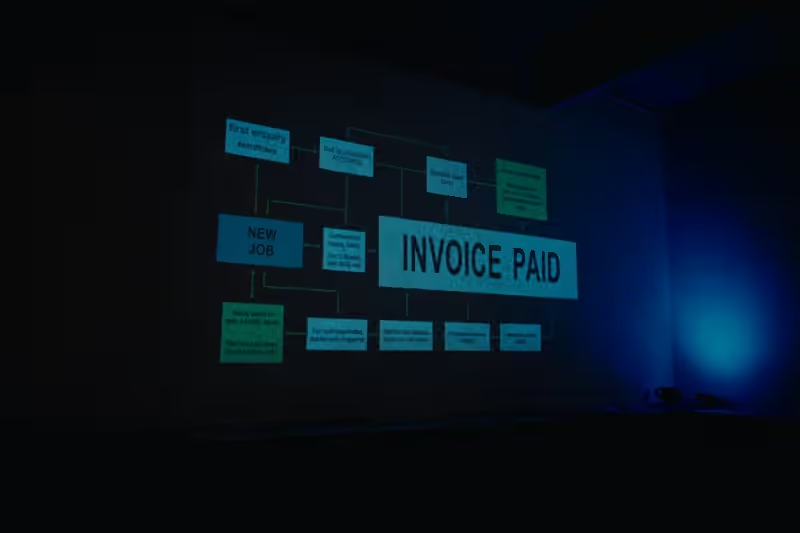
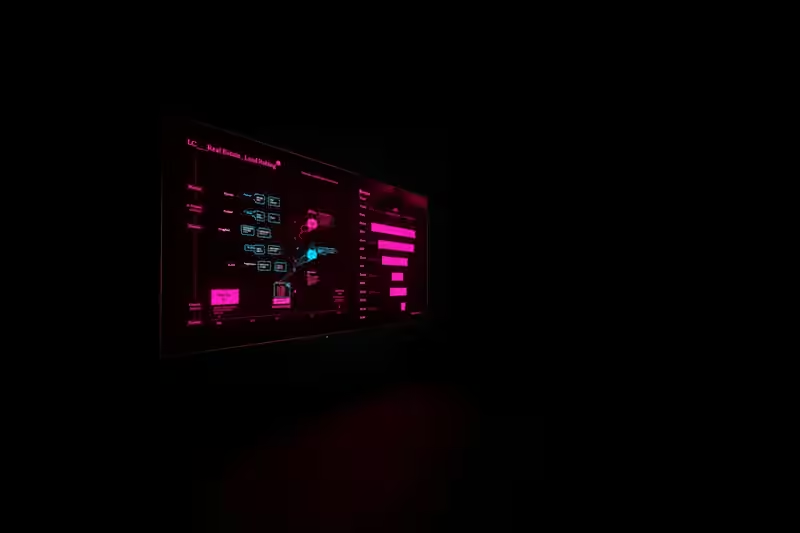
We start by mapping how a job travels from first enquiry to paid invoice, then attach a number to every place it stalls. What comes back is a ranked list with an estimated annual cost against each item, and a recommendation on which ones are worth your attention.
What this covers
Operating diagnostics across sales, delivery, and administration
Competitive analysis and market entry
Process and organisational design
Pricing, quoting, and margin analysis
Technology stack review and consolidation planning
Job costing and utilisation reporting that managers will open
Exit readiness: the systems and documentation an acquirer expects to find
Specify it properly, then build it or hand it over
Two kinds of work sit here, and they share a discipline: nothing gets committed until it has been specified in a form somebody else could execute.
Software and platform. Architecture, product engineering, data infrastructure, and the integration work that decides whether a system is used or quietly abandoned. Everything ships with documentation and handover notes.
Audio visual design. Technical design and consulting for international and European projects. You receive system drawings, a costed bill of materials, and a written risk assessment before anyone commits to hardware, then a handover package your production partner can bid against without interpretation. Thirty years of show days sit behind the numbers, including the ones that failed at four in the morning.
What this covers
Platform architecture, product engineering, and data infrastructure
Technical system design and drawings
Creative direction and content strategy for large-format displays
Budget modelling and cost estimation
Venue feasibility: sightlines, power, rigging, and load-in access
Tender and RFP documentation, and independent bid review
Interaction and audience-flow design for installations
Design brief handover to your production partner
The audio visual practice provides design and consulting services only. Production management, on-site delivery, and vendor procurement are outside its scope.
Growth is architecture, not luck. When good creative underperforms, the cause is almost always downstream of the advertisement: a form nobody monitors, a follow-up that fires three days late, or a pipeline stage that was never defined. We start with the revenue system underneath the marketing, then work up to positioning and message, because in the other order the message has nothing to land in.
What this covers
Positioning and messaging for technical products and services
Lead capture, routing, and speed of response
CRM architecture and pipeline design
Lifecycle email, nurture, and reactivation strategy
Attribution modelling you can defend to a board
Technical SEO and site architecture
Sales enablement: proposal structure, one-pagers, and follow-up assets
Reporting designed for owners rather than analysts
Full-service campaign production, brand development, and creative execution run through The Business Operators, the sister operation. FrameShift covers the operating layer: the data, the systems, and the revenue process underneath the campaign.
Most organisations approach AI by purchasing a tool and then searching for a use case. The result is a subscription nobody cancels and a workflow nobody trusts.
We invert the order. Find the handoffs consuming the most staff time, work out which of them tolerate a machine making the transfer, and specify the guardrails before a single integration is built. Judgment stays with your people. The copying, chasing, and reminding does not.
What this covers
Automation opportunity assessment across the tools you already pay for
Build or buy analysis with three-year total cost of ownership
Model selection, cost control, and token budgeting
Data governance: residency, retention, and access control
Guardrails, audit logging, and human review gates
Implementation roadmap sequenced by payback
Independent review of a platform or vendor you are considering
The consulting practice works because the build side exists. These are the three studio threads it draws on — all active, all visible in the work itself.
Material, motion, light and software without a client brief.
01in the studio
Art for myself
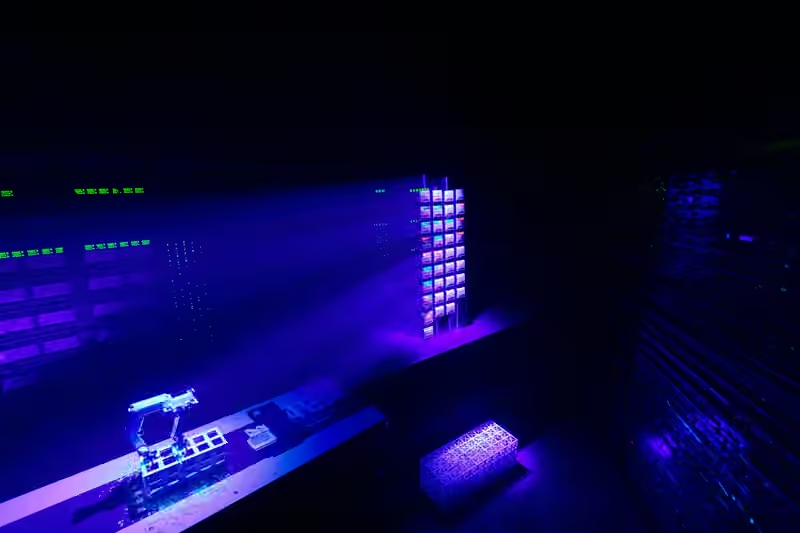
No client. No brief. No committee. This is where sensing, projection, light, sound, physical materials and deliberately strange software can be tested before anyone asks them to behave. The studio work includes kinetic objects, responsive environments, generative images and small machines that reveal an unexpected rule when someone approaches. It is research through making: some experiments become commissions, some become reusable technical methods and some remain singular artworks. All of them sharpen the taste and practical knowledge behind the work made for other rooms.
The audience, architecture and system designed together.
02open for commissions
Commissioned for your room
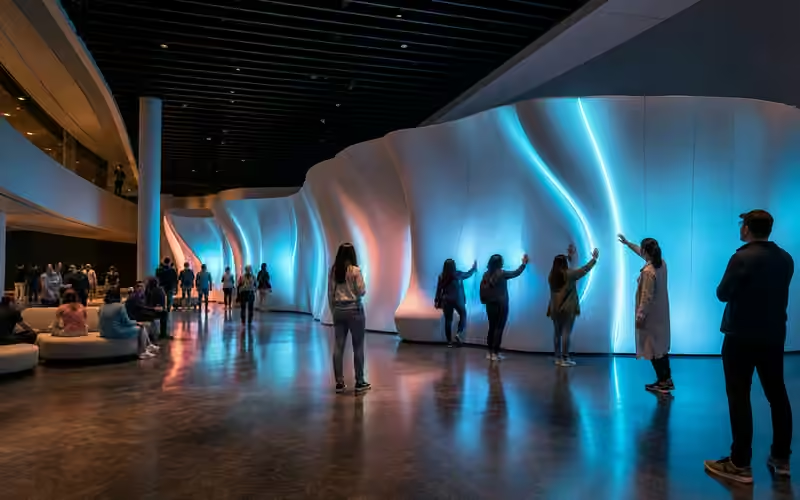
Custom interactive artwork, built one-of-one for the audience and architecture it belongs to. A commission can be a responsive sculpture, an immersive room, public-facing media art, a playful brand activation or a permanent installation that changes as people move through it. The process covers concept development, spatial and interaction design, sensing, media, fabrication, control systems, testing, installation and operation. Thirty years of event technology means the artwork is planned for access, power, sightlines, maintenance, queues and real human behaviour—not only the perfect demonstration. Eccentric does not mean unreliable.
Participant-facing delight and operator-facing control.
03shipping now
Purpose-built software
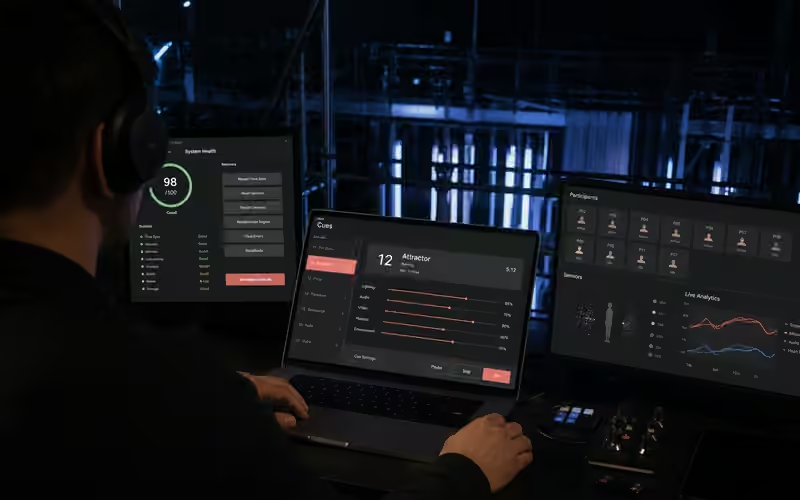
Apps and tools built for exactly one purpose: yours. That can mean an interactive game engine, show-control interface, registration and scoring flow, sensor bridge, content-management tool, data visualisation, kiosk, installation dashboard or an integration between systems that were never designed to speak. The software is shaped around the operator as carefully as the participant, with offline behaviour, recovery tools, useful logging and clear handover built in. It is not a subscription or a template disguised as custom work. If the problem is unusual, that is usually where purpose-built software creates the most value.
You describe where the work stalls. You get an initial read on whether the constraint is process, tooling, or people, and a straight answer on whether we are the right firm. If we are not, we will say so and point you somewhere better. No charge.
02
Diagnostic
Interviews, a walkthrough of the systems in daily use, and a documented map of how work and information actually move. Delivered as a written report with a ranked list of failures, an estimated cost against each, and an estimate for anything worth building.
03
Specification
The chosen fixes are written as an implementable specification: requirements, acceptance criteria, data model, and integration points. This document is deliberately vendor-neutral. Hand it to us, to your internal team, or to a third party. It is yours either way.
04
Build or advise
Either we build the specified system, or we oversee whoever does. Build work concludes with documentation, a recorded handover, and a system running on infrastructure you own.
Everything produced at each stage is yours, whether or not you continue to the next one.
://how we charge
Priced to the shape of the problem
Some problems take an afternoon. Some take a year. Pretending both fit the same package helps nobody, so there are three shapes and we agree which one applies before any work starts.
Single session
A specific decision, resolved in a few hours. A platform selection, a bid review, a design critique, or a second opinion on a proposal someone has put in front of you. Fixed fee, one deliverable, no ongoing commitment.
Defined project
A diagnostic, a specification, a design package, or a build. Scoped in writing with agreed deliverables and a fixed price against that scope. Changes are priced openly rather than absorbed quietly or invoiced as a surprise.
Retainer
An agreed block of hours each week for as long as it is useful. Some clients run five hours a week, some run twenty. Some run it for a month, some have no end date in mind. You get a priority queue you control, a standing working session, and a written monthly summary of what changed and what it cost.
No minimum term on the retainer and no automatic renewal. If a month passes where it was not worth the money, say so and we will fix it or end it.
://why this combination is unusual
The credentials, plainly
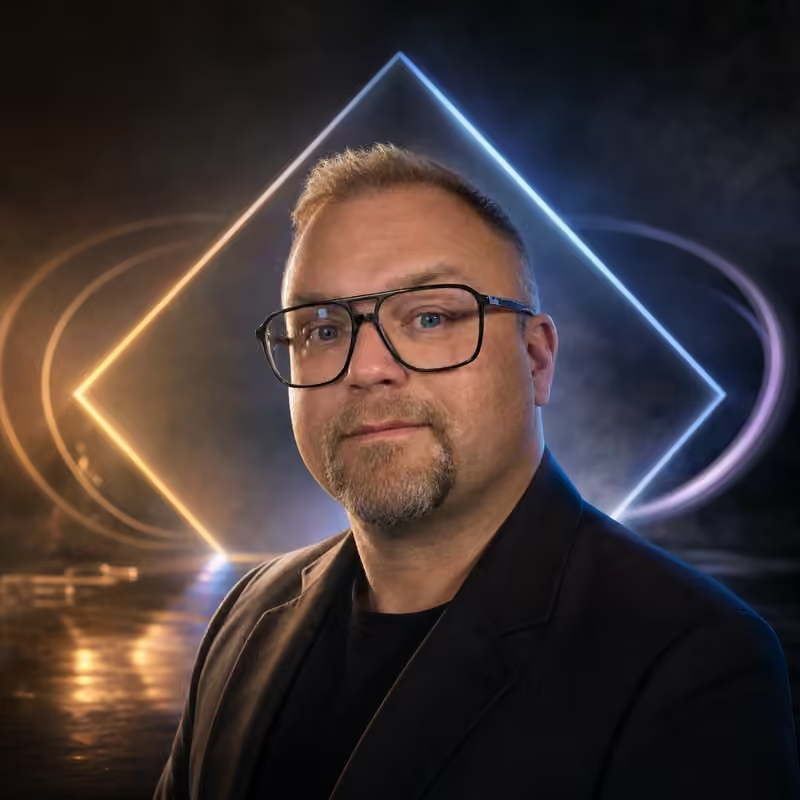
Christoph Mayer — founder, FrameShift
Operator experience, not observed experience.
Christoph Mayer founded an audio visual company, built it to three offices and sixty staff, and sold it to private equity. The advice comes from having carried the risk, not from studying companies that did.
Thirty years where the deadline was doors open.
First show in 1996. Roughly 4,500 since. Live events do not permit a second attempt, which is a useful thing to have learned before advising anyone on a system that has to work on a specific day.
One accountable party from diagnosis to handover.
Large firms pass a project from a strategist to an architect to a delivery team, and the original intent degrades at every seam. Here it does not get handed off.
Written before spoken.
Every engagement produces a document: a diagnostic, a specification, or a design package. You are never asked to act on the memory of a conversation.
English and German.
Based in Schwäbisch Hall, with dual Canadian and German citizenship. Documentation, tender packages, and client-facing material in either language, or both.
://what you own
Own the system. Control where it lives.
A supplier who keeps the keys keeps the client. That is a commercial model, not a professional standard. Everything we produce is handed over in a condition you could take to another supplier tomorrow, which is the only honest test of whether it was built properly.
Your accounts, your credentials.
Systems run on infrastructure you control and pay for directly. No reseller margin sitting between you and your own tools.
Source and documentation transferred.
Code, configuration, and written handover notes belong to you at the end of the engagement. Handover is scoped as product work, not written on the last afternoon.
Data residency on request.
EU hosting and self-hosted deployment where compliance, procurement, or client contracts require it.
No proprietary runtime.
Nothing depends on a private platform you cannot leave. If you stop working with us, the system keeps running.
://frequently asked
Frequently asked questions
We already work with an agency. Does this replace them?
Usually not. Most of this work sits underneath an agency's output rather than competing with it: the CRM the leads arrive in, the routing that decides who calls them, and the reporting that shows whether the retainer is worth renewing. Agencies confident in their work tend to welcome having that layer repaired.
Are you a consultant or a developer?
Both, and that is the proposition. Each half on its own produces one of the two expensive failures described at the top of this page.
How small is too small?
Below five people with no recurring revenue, a diagnostic will not repay its cost yet, and you will be told that on the first call rather than sold one.
Can you work as a subcontractor under our brand?
Yes. White label and named subcontracting are both available, under a written scope.
We only need a few hours of your time. Is that worth booking?
Yes. A single session on a platform decision or a bid review is a real engagement, not a favour, and it is often the highest-return thing on this page.
What if the recommendation is that we should not build anything?
Then that is the deliverable. A diagnostic concluding that your process is sound and the real constraint is a hiring decision has saved you a six-figure build. It happens more often than the industry admits.
Where do you work?
Based in Schwäbisch Hall, Germany. Engagements run across Europe and North America, remote first, on site where the work requires it.
Bring the problem, not the brief
Describe where the work stalls. You will leave the call with an initial read on whether the constraint is process, tooling, or people, and a direct answer on whether this is worth paying for.